AI SEO Tools Every Marketer Should Use: A Digital Marketer’s Toolkit for Smarter Rankings
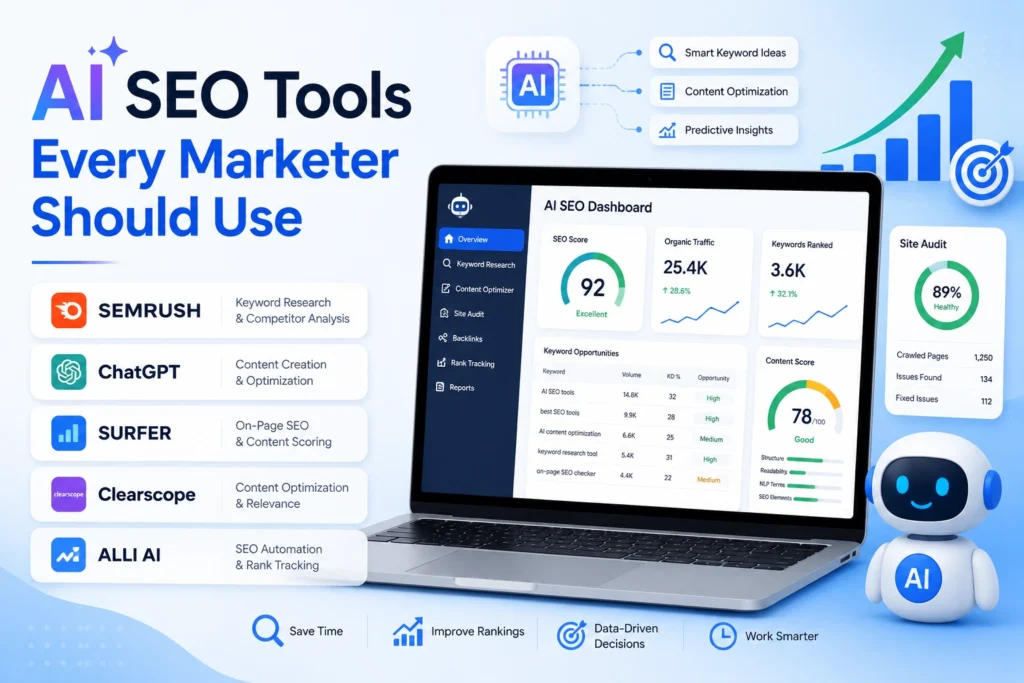
Introduction: Why AI Has Become Essential to Modern SEO Search engine optimization has transformed dramatically over the past few years, and artificial intelligence now sits at the core of that transformation. Consequently, every digital marketer must adapt to a landscape where success depends not only on traditional ranking factors but also on visibility within AI-generated search summaries. As search engines evolve, the tools marketers rely on must evolve alongside them. Moreover, manual SEO processes, such as keyword research, content audits, and competitor analysis, once consumed enormous amounts of time. Today, AI-powered platforms complete these tasks in a fraction of the time while often producing more accurate, data-driven insights. Therefore, understanding which tools genuinely deliver value has become a critical skill for anyone responsible for organic growth. The Shift From Traditional SEO to AI-Driven Optimization Traditional SEO historically focused on ranking within Google’s ten blue links, but that landscape has expanded considerably. Because AI-generated answers now appear across platforms such as ChatGPT, Perplexity, and Google’s AI Overviews, marketers must optimize for a much broader ecosystem. As a result, the discipline once known simply as SEO now increasingly overlaps with Generative Engine Optimization, or GEO. Furthermore, this shift does not eliminate the importance of traditional ranking fundamentals; rather, it builds upon them. Since many AI platforms still draw from established search indexes, strong technical SEO and authoritative content remain foundational. Consequently, the most effective tools address both traditional visibility and emerging AI-driven discovery simultaneously. Semrush: A Comprehensive Platform for Visibility Across Channels Semrush has long served as an all-in-one solution for keyword research, competitor analysis, and site auditing. In recent years, the platform has expanded its capabilities to track brand visibility across AI platforms, monitoring how often a brand appears within AI-generated answers across multiple regions. As a result, marketers gain a unified view of both traditional rankings and AI search presence. In addition, Semrush’s AI-assisted features help streamline everyday workflows, including content recommendations and site health monitoring. Because the platform consolidates so many functions into a single dashboard, agencies and in-house teams alike can reduce the number of separate tools they manage. Therefore, Semrush remains a strong starting point for any digital marketer seeking a comprehensive, data-rich foundation. Ahrefs: Backlink Intelligence Enhanced by AI Ahrefs built its reputation primarily on backlink analysis, and that strength continues to anchor its platform today. Because backlinks remain a significant ranking factor, Ahrefs’ frequently updated index gives marketers a reliable foundation for competitive research. Consequently, the tool remains especially valuable during client onboarding, when understanding a competitive landscape quickly matters most. Moreover, Ahrefs has layered AI capabilities on top of its existing dataset, streamlining keyword research, content planning, and technical audits. This integration allows marketers to move from raw data to actionable insight more efficiently than before. As a result, teams that already rely on Ahrefs for backlink research can extend its value into broader AI-informed strategy without switching platforms entirely. Surfer SEO: Real-Time Content Optimization Surfer SEO focuses specifically on content optimization, analyzing top-ranking pages to guide structure, terminology, and target length. Its Content Editor provides real-time scoring as writers draft their content, which helps ensure alignment with what search engines already reward. Consequently, teams producing high volumes of content benefit from immediate, actionable feedback rather than waiting for post-publication analysis. In addition, Surfer has expanded its semantic analysis capabilities, moving beyond simple keyword density toward genuine topical relevance. Because this shift mirrors how search engines themselves evaluate content quality, writers using Surfer tend to produce material that satisfies both algorithms and human readers. Therefore, this tool works particularly well for teams that prioritize consistent, scalable content production. Clearscope and Frase: Optimizing Human-Written Content Clearscope specializes in helping writers refine already-drafted content by scoring it against top-ranking competitors in real time. Since many teams prefer to maintain a human-first writing process, this tool fits naturally into workflows where AI assists rather than replaces the writer. As a result, Clearscope appeals strongly to teams that value editorial control alongside data-driven guidance. Similarly, Frase combines keyword research, content briefs, and an integrated editor into a single streamlined workflow. It analyzes top-ranking pages for a given keyword and generates outlines based on those findings, saving considerable research time. Furthermore, Frase has begun incorporating dual scoring that evaluates content against both traditional search results and emerging AI platforms, reflecting the industry’s broader shift toward GEO. MarketMuse and SE Ranking: Strategic Planning and All-in-One Value MarketMuse takes a more strategic approach by modeling topical authority across an entire website rather than optimizing individual pages in isolation. Its AI inventories existing content and produces prioritized topic clusters, helping marketers identify content gaps before competitors fill them. Consequently, this tool proves especially valuable for teams building long-term content strategies rather than isolated campaigns. Meanwhile, SE Ranking offers a strong price-to-value ratio by combining rank tracking, site audits, keyword research, and AI-powered content optimization within one platform. Because it delivers a broad feature set without the premium pricing of larger competitors, SE Ranking suits smaller teams and growing agencies particularly well. Therefore, marketers operating with tighter budgets can still access many of the same core capabilities found in more expensive platforms. Tracking Brand Visibility Across AI Platforms As AI-generated answers increasingly influence how consumers discover brands, tracking visibility within these platforms has become just as important as monitoring traditional rankings. Several tools now specialize in this exact function, showing marketers where their brand appears across ChatGPT, Perplexity, Gemini, and Google’s AI Overviews. Consequently, this visibility data reveals opportunities that traditional rank tracking alone cannot capture. Furthermore, some of these platforms identify the specific sources that AI systems cite most frequently, such as review sites, forums, or comparison articles. By understanding which sources already earn AI trust, marketers can pursue placements on those platforms to indirectly strengthen their own visibility. As a result, AI visibility tracking has emerged as a distinct discipline that complements, rather than replaces, traditional SEO monitoring. How to Choose the Right AI SEO Tool for Your Team Selecting